
When an Ordinary Place Is Enough
I am a little cautious about saying a photographer has influenced me. Not because influence is a bad word, but because it can sound more direct than it usually is. It can make it seem as if one artist looks at another artist’s work and then goes out trying to make a version of it. That is not usually how it feels to me.
More often, another photograph, painting, or image gives me permission to notice something. It reminds me that a quiet building can be enough. A storefront can be enough. A roadside structure, a patch of weathered wall, a sign, a window, a broken edge, or a place that looks as if most people have stopped paying attention to it can still carry visual weight.
That idea has been on my mind as I think about the kinds of images I return to, and the kinds of places I keep wanting to photograph.
The weight of a simple scene
Allison V. Smith’s photograph from her Texas gallery is a good example. The image is built from very few elements: the geometry of modest buildings, a nearly monochrome palette, a wet or weathered surface, and a dark sky pressing down behind it. There are no people in the frame, and very little to tell us exactly where we are.
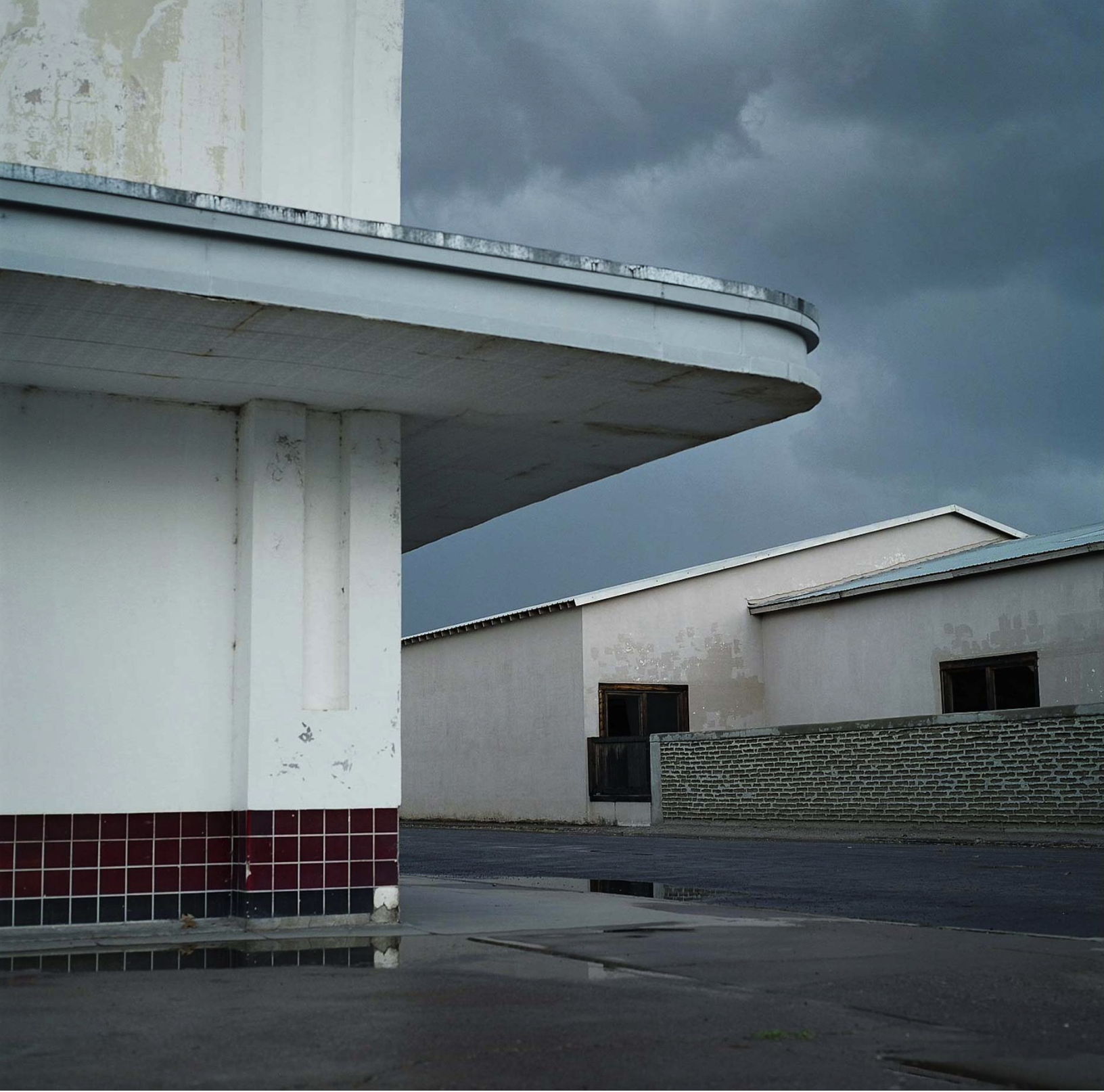
Allison V. Smith, image from the Texas gallery. Image source: allisonvsmith.com. © Alison V. Smith.
That absence is part of what holds my attention. The place feels ordinary, but not empty. The light wear on the surfaces, the tile, the pavement, the puddle, the distant buildings, and that heavy sky all begin to suggest a story without explaining it. Is the location abandoned? Neglected? Ignored? Still in use? The photograph does not answer those questions, and I like that it does not try to. It simply asks us to stay with the place a little longer.
A storefront as a record of use
Walker Evans does something different, but related, in License Photo Studio, New York. The building itself is not grand. It is a commercial facade covered in signs, typography, arrows, circles, rectangles, and fragments of street language. In its day, the signage was meant to get attention. In the photograph, it becomes something more layered.
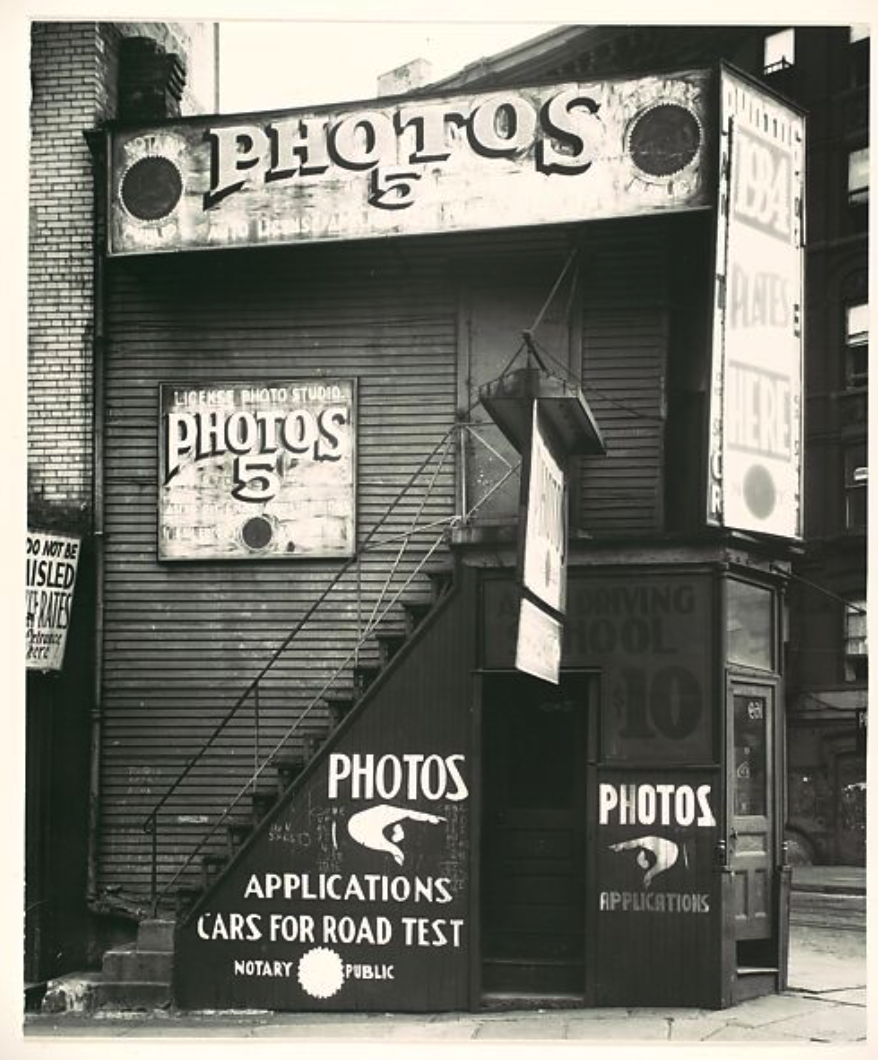
Walker Evans, License Photo Studio, New York, 1934, printed ca. 1970. Gelatin silver print. © Walker Evans Archive, The Metropolitan Museum of Art.
The whole building starts to read almost like one large billboard, but also like a record of use. The signs point, repeat, compete, and overlap. The graphics are practical, but visually alive. Evans’ framing leaves just enough around the edges to remind us that this storefront belongs to a larger neighborhood and city.
What interests me is how direct the photograph feels. It does not appear to be trying to make the building beautiful. It gives the building enough attention that the viewer has to take it seriously. That may be one of the things I respond to most in photographs of ordinary places. They do not need to be romanticized. They do not need to be rescued. They can be looked at plainly and still become rich.
The subject choice matters
Rod Penner brings that same kind of attention into painting. His J & H Station / May, TX is almost unbelievable at first because of its technical precision. I have seen his work in person, and the paintings are just as remarkable when you are standing in front of them. But as impressive as the realism is, that is not the only reason the work stays with me.
It is the choice of subject.
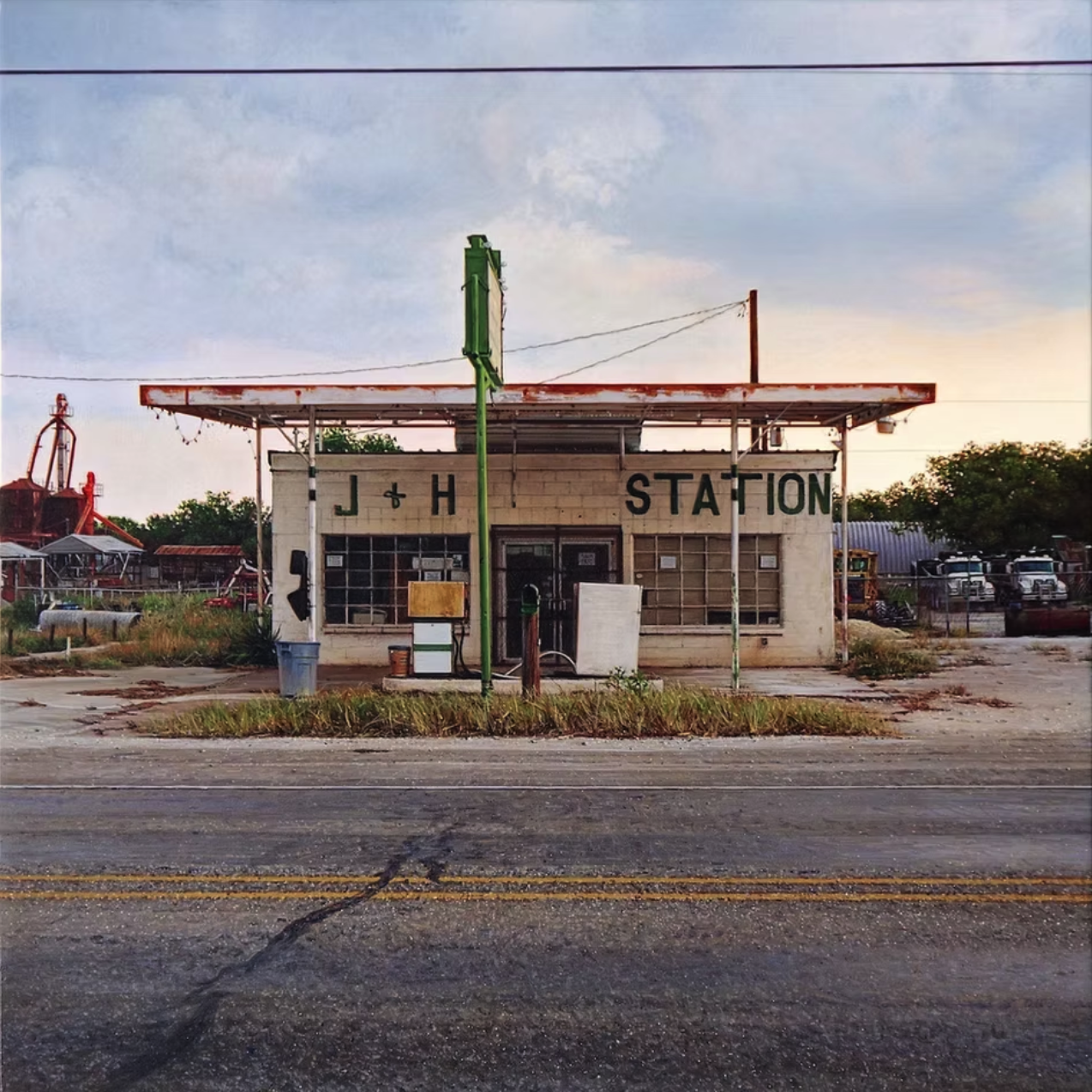
Rod Penner, J & H Station / May, TX, 2021. Acrylic on polyester over birch panel, 10 × 10 in. Image source: rodpenner.com. © Rod Penner.
A small, utilitarian roadside building becomes the center of the painting. The station is weathered, quiet, and no longer performing the function it was built for, or at least not in the same way. The scene is straightforward, but not casual. Penner gives the building pride of place. He paints it with so much care that the question becomes less “how did he make this look so real?” and more “what made him stop here?”
That question matters to me, because stopping is often the first act of making a photograph.
The image that was across the street
My photograph After the Bell came from that kind of stopping, though not right away. I made it in Ardmore, Oklahoma, after a building on the main road first caught my eye. I parked the car and went to explore it with my camera. Fairly quickly, I realized it did not quite do it for me. There was potential, but not enough.
Then another building across the street caught my attention. I walked around it for a while and made some photographs I liked well enough. But the image I kept was waiting somewhere else.
On the way back to my car, I noticed a small courtyard near what appeared to be an old elementary school — a 1930s building with a later addition from around the 1960s. It had been across the street the whole time, but I had not really seen it until then.
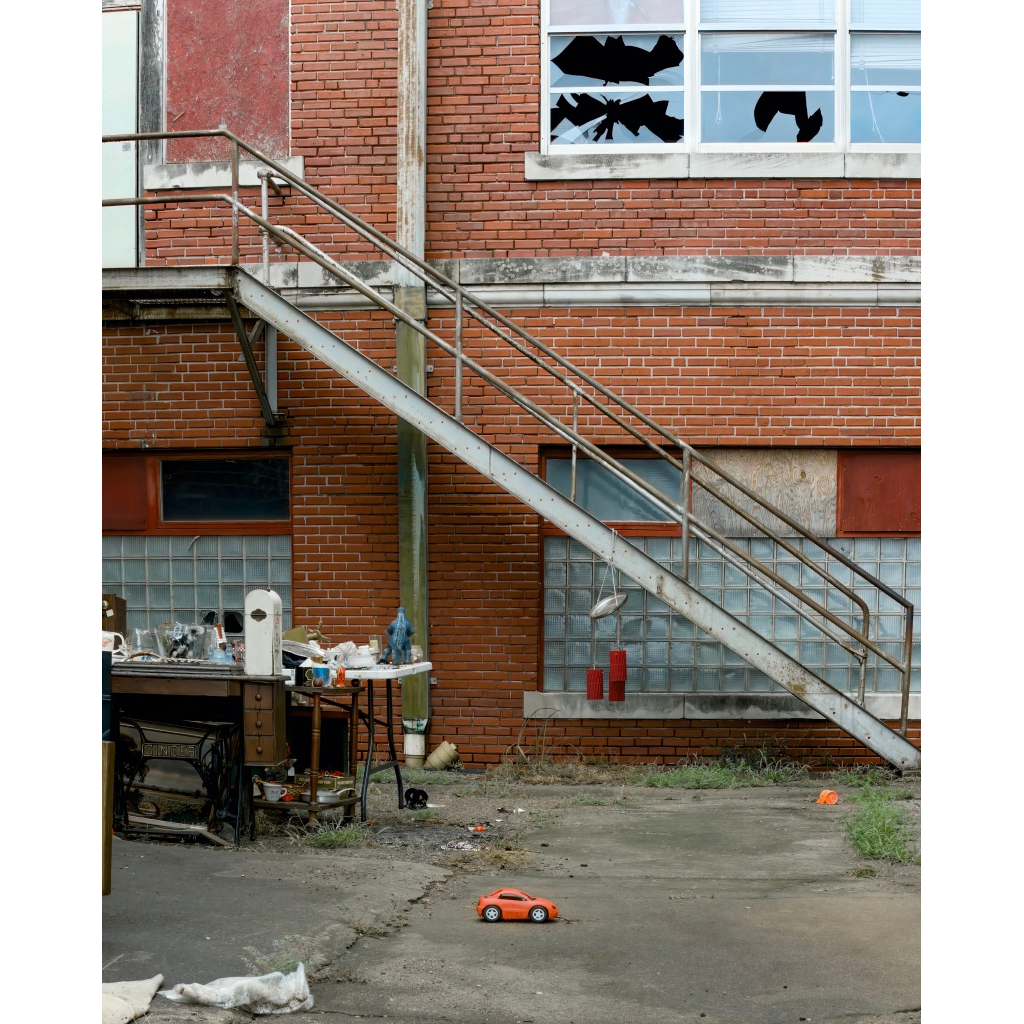
Tom Venner, After the Bell, Ardmore, Oklahoma. From the At the Edge of Town gallery. © Tom Venner
The brick wall, exterior stairs, glass block, broken windows, and grass all made a strong backdrop. But the foreground is what stopped me: an odd collection of objects sitting outside, especially the small red toy car.
That toy car is the subject of the photograph for me. Why is it there? Who did it belong to? How long has it been sitting in that courtyard? Was the building abandoned, or only partly abandoned? Was someone still using the space? I do not know the answers, and not knowing is what keeps the image alive.
Ordinary, but not empty
After the Bell belongs in my At the Edge of Town gallery because the place is literally and visually on an edge. It is not quite active, not quite forgotten, not quite explained. It feels like a location that may have outlived its original purpose, but still holds evidence of use, absence, repair, neglect, and maybe even play.
That is what ordinary places can do. They can carry the traces of people without giving us the whole story. They can hold weather, time, signage, color, damage, memory, and small unanswered questions. They can be overlooked for years and still become visually charged the moment someone stops long enough to look.
Other artists do not make me want to copy what they have seen. They remind me that noticing is enough of a beginning.
A building does not have to be historic. A sign does not have to be famous. A roadside structure does not have to be beautiful. A courtyard does not have to explain itself.
Sometimes an ordinary place is enough.
