
The Cyclist I Didn’t See Coming
The subject of this photograph is the cyclist. I just didn’t know that when I took it.
This was in Berlin, during my first visit to the city. We were walking along Augustastraße on our way to Clärchens Ballroom. It was a beautiful September day — sunny, comfortable, and the kind of day that makes it easy to keep walking. I had my camera with me, but no specific objective beyond looking around and seeing what might be worth photographing.
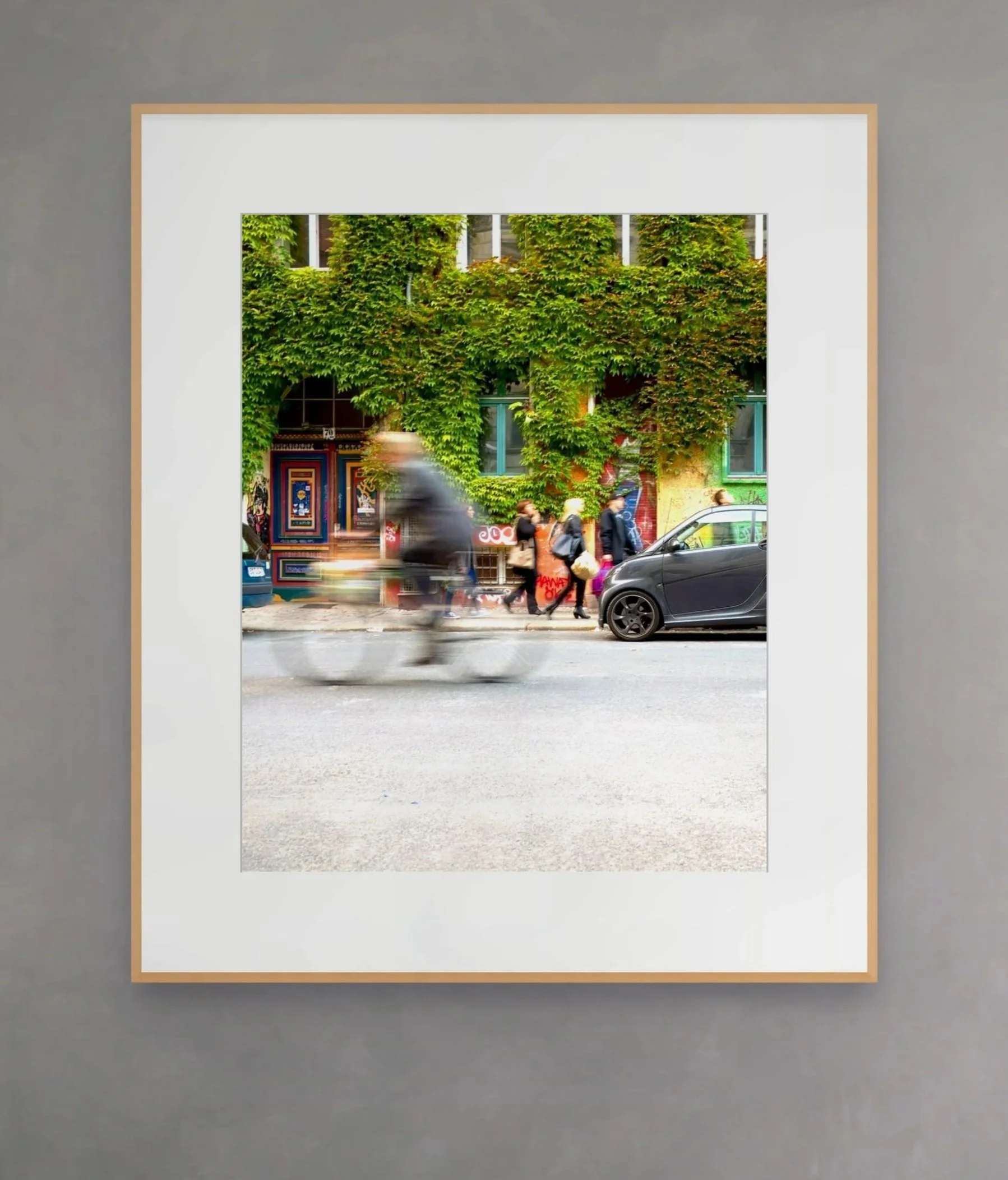
An unexpected cyclist moves through the frame on Augustastraße in Berlin, turning an ivy-covered street scene into a photograph about motion, timing, and paying attention.
At first, what stopped me was the ivy.
It seemed to cover nearly the entire facade of the building, turning the wall into a dense green surface. The windows and edges were still visible, but only partly. The building felt both hidden and present, as if the architecture had been softened by time, growth, and weather.
Then I started noticing the rest of the scene.
The colorful doorway at street level. The graffiti near the lower wall. The parked Smart Car at the curb. The people walking along the sidewalk. The more I looked, the more the neighborhood seemed to gather itself inside the frame. Nothing was arranged, but everything had a role.
I liked the Smart Car immediately. It felt very European to me, which may be an obvious thing to say about a street scene in Berlin, but sometimes obvious details are still useful. It gave the photograph color, structure, and scale. The doorway did something similar. It kept the building from feeling abandoned or forgotten. The ivy may have been taking over the facade, but the street still felt current and lived in.
At that point, I thought I knew what I was photographing.
I was trying to make an image about the building and the sidewalk in front of it. I wanted the pedestrians in the frame because they gave the scene a more organic contrast. The facade was dense and still; the people brought scale and movement. So I kept shooting, waiting for them to land in the right place.
Then the cyclist blew through the frame.
I do not remember seeing him come in from the right. I was not trying to make a motion-blur photograph, and I do not remember choosing a slower shutter speed for effect. He simply arrived while I was focused on something else, and the camera caught him as a blur.
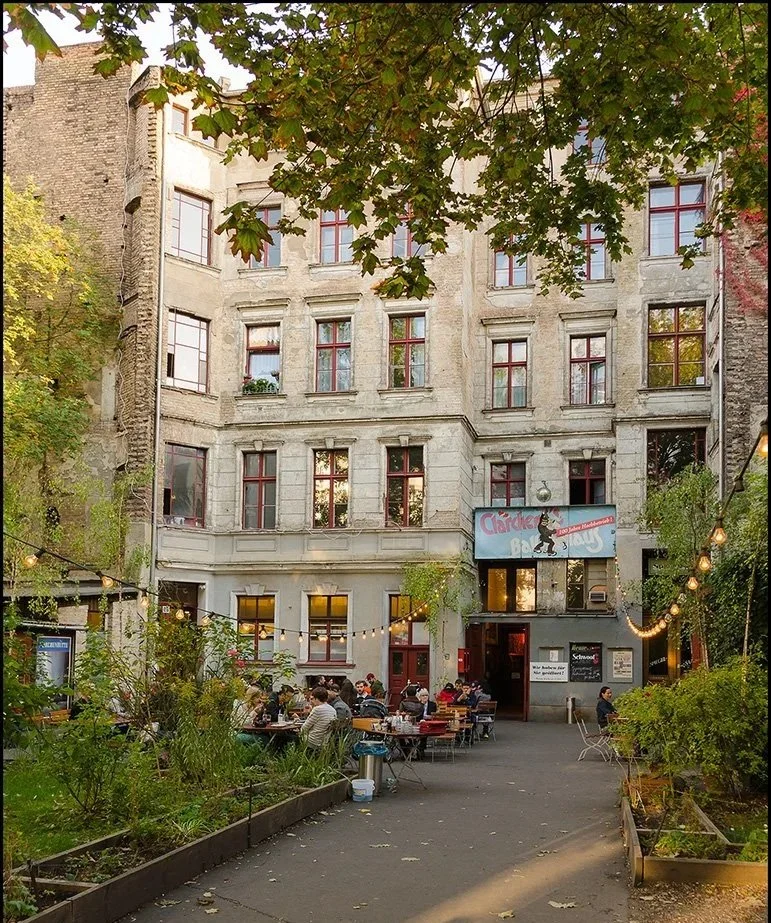
The courtyard at Clärchens Ballhaus, a Berlin ballroom and gathering place that has been part of the city’s cultural life since 1913. Visit Clärchens Ballhaus.
A very good interruption.
When I looked through the images later, this was the frame that stopped me. Not because it was the cleanest or most carefully planned, but because the cyclist changed the whole photograph. The image was no longer only about the ivy-covered building, the doorway, the car, or the pedestrians. It was about the city moving through all of it.
That is what I still like about the photograph. The cyclist is not the sharpest element in the frame. He is not even fully described. But he gives the image its pulse. He turns the photograph from a street scene into a street photograph.
There are three ways of moving through the city here: walking, bicycling, and driving. The pedestrians are mid-stride. The cyclist is already passing. The car is parked and waiting. Each has a different pace, and together they give the image its rhythm.
This photograph is included in my Signs of Life gallery, which feels like the right home for it. It is a picture of a neighborhood in motion — marked, inhabited, overgrown, colorful, and very much alive.
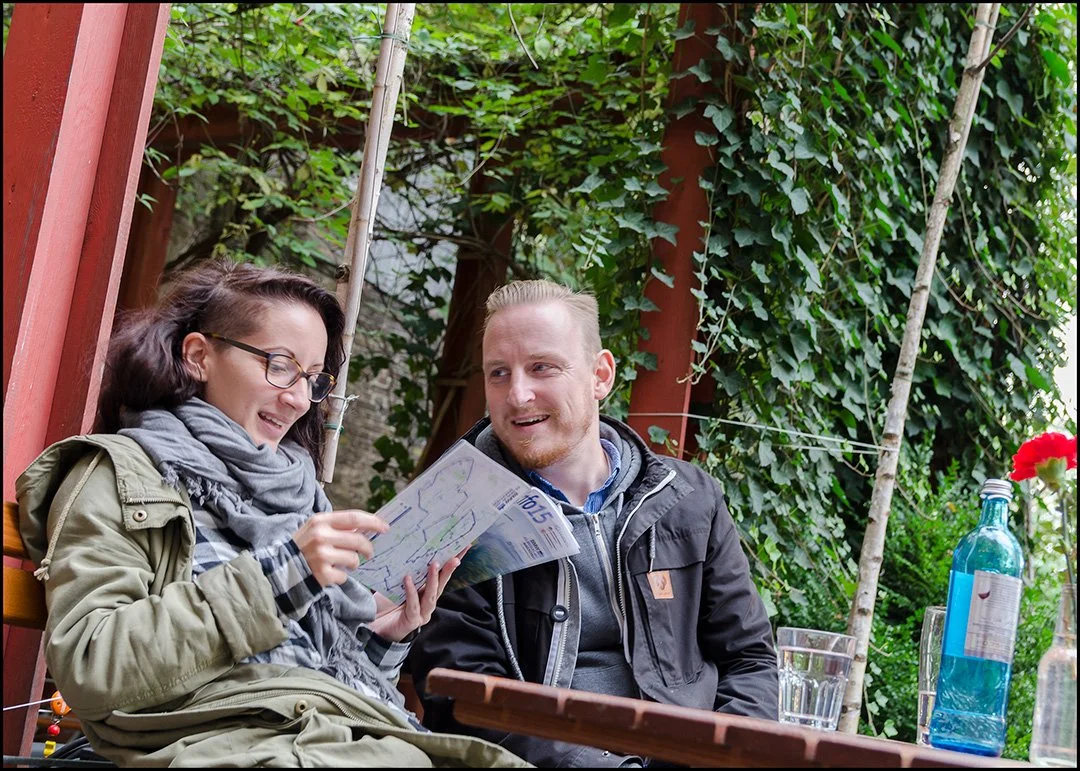
Table neighbors enjoying a quiet moment at Clärchens Ballhaus, where the afternoon slowed down after a walk through the neighborhood.
I think this is one reason I keep returning to photography as a way of paying attention. You can begin with one subject and end up with another. You can frame the building, wait for the pedestrians, notice the car, and still have the real photograph arrive from the edge of the frame. The work is partly looking, partly waiting, and partly being open to the thing you did not know you were there to see.
Sometimes the best part of a photograph is the part you plan for.
Sometimes it is the part that arrives uninvited.
